Words from the cold North
The Nordic invasions: 10 words adopted by English
Published on February 12, 2026
 Credit: Sami Matias Breilin
Romance languages, led by French, have had such a lasting influence on English that we sometimes forget that it is actually a Germanic language, and as such, a relative of the Nordic languages.
However, Nordic languages had left their mark on English centuries before the French-Normans even attempted to conquer England, and they continue to do so to this day. Let’s have a look at some words of Nordic origin that are ingrained in everyday English.
Window
 Credit: R Mo
The terms for window used by Old English and Old Norse were both related to the word ‘eye’, but were different. In Old English, the common word was eagþyrl or ‘eye-hole’, while Old Norse used vindauga or ‘wind-eye’. V_indauga_ was one of the many words adopted into English during the Viking invasions and evolved into ‘window’ during the Middle English period.
Egg
 Credit: Mustafa Bashari
Did you know that the original English word for egg was æg, and it was pronounced like ‘eye’? The word as we know it now was adopted from Old Norse around the 14th century. For a while, egg coexisted with eyren, the plural of æg, but the Norse term was ultimately more popular.
Fjord
 Credit: Ferdinand Stöhr
What do the words fjord, ford, and port have in common? They all come from the same Indo-European word meaning ‘crossing’, but through different languages. Old English ford retained the meaning of ‘a shallow river crossing’, while Latin portus was adopted as port (a harbor), and Old Norse fjǫrðr was adopted as fjord (an inlet or estuary that gave passage from the sea to the land).
Ski
 Credit: Maarten Duineveld
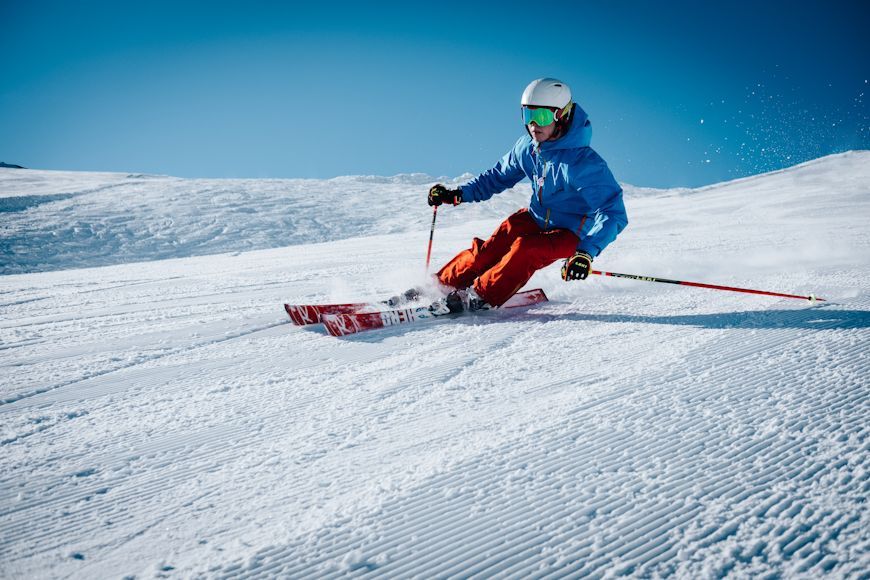
Nordic countries deal with much more snow than England, so the adoption of snow-adjacent vocabulary seems only logical. In addition to this, most of the English terms that start with sk- are of Norse origin. The word ski comes from the Old Norse skíth (meaning ‘snowshoe’), and it was adopted into English during the 18th-century. Related words such as slalom (a sloping track) are of the same origin.
Moped
 Credit: Ruslan Bardash
This word, from Swedish origin, was adopted in the 1950s, but it is actually a portmanteau. The original name was trampcykel med motor och pedaler or ‘pedal cycle with engine and pedals’. It seems that the name was a mouthful even for the Swedish, because the shortened version was coined by them.
Gang
 Credit: Hannah Busing
Nowadays, gang can have a negative connotation in some contexts, but it can also be used in a more neutral sense. This neutral use (gang as ‘group’) comes from Old Norse gangr or ganga, meaning ‘going’ or ‘journey’. Adopted into English, the meaning of gang shifted to ‘a group of people’.
Want
 Credit: Christian Lue
People want the things that they don’t have, and that is the origin of this very important English verb. In Old Norse, vant was a neutral form of vanr, ‘deficient, lacking’. Vanta was ‘to be lacking’. Although the word was adopted by English with the meaning of ‘lacking’ something, its original notion was later extended to ‘needing’ and then ‘desiring’.
Scuffle
 Credit: Devon Janse van Rensburg
The origins of this term are Scandinavian, most likely the Swedish skúfa, meaning ‘to shove’ or ‘to push’. It was adopted into English in the 1500s to describe small, clumsy tussles and fights, though it later adopted also the meaning of moving in a confused or hurried way.
Hygge
 Credit: Sixteen Miles Out
A much more modern term, hygge became popular in English in the last decade. This Danish word is impossible to translate, and it's used to describe a feeling of coziness, contentment, and comfort. Through its Old Germanic roots, hygge is related to the English hug.
Geyser
 Credit: Emily Campbell
Did you know that geysers are named after an Icelandic geyser called Geysir? The name comes from the Icelandic verb geysa, meaning ‘to gush’ or ‘to go forward’. The Icelandic word for geyser is goshver, but Geysir was so famous that English adopted it as a generic name for all spouting hot springs in the 18th century.